


 All News
In highly efficient new buildings in operation, embodied carbon can account for 50% to 70% of total lifecycle emissions (RICS, Whole Life Carbon Assessment, 2nd edition, 2023). The more efficient a building is in use, the greater the relative share of embodied carbon.
The scale of the challenge is structural:
At a European level, this issue is no longer voluntary. The revised EPBD (Directive 2024/1275) requires the calculation and disclosure of Global Warming Potential across the lifecycle — for new buildings over 1,000 m² from 2028, and for all new buildings from 2030. The European Commission’s Level(s) framework, the EU Taxonomy and CSRD/ESRS E1 already require, or will require, that embodied carbon is measured, reported and progressively reduced.
Sustainability is therefore increasingly determined at an early stage: at concept design, in the selection of construction systems, in the quantity of materials used, and in the ability to optimise solutions before construction begins. Addressing embodied carbon means answering four key questions: which materials, from which origin and production process, in what quantities, and with what potential for reuse or recovery at the end of life.
Building better, therefore, means building with a rigorous awareness of what is embedded within the building itself – and measuring it in kgCO₂e/m², not in intentions.
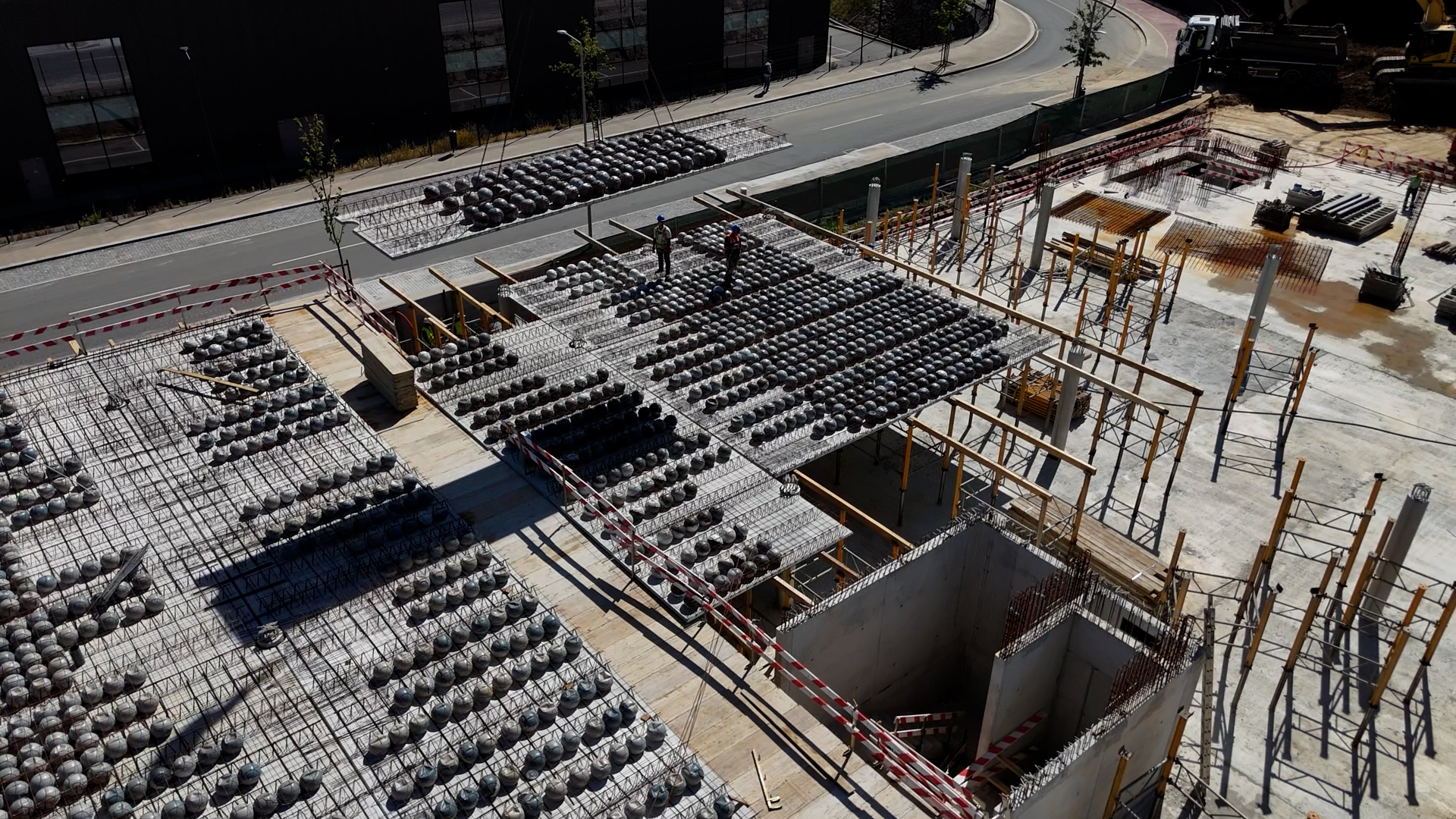
The industrialisation of construction becomes particularly relevant in this context. More precise, standardised and digitalised methods enable waste reduction, improved resource management and greater process predictability.
Systems such as BubbleDeck – a solution that reduces the volume of concrete by incorporating hollow spheres into slabs – reflect this logic of efficiency. By enabling a more rational use of materials, it can contribute to lowering the carbon footprint associated with the structure, while also allowing for larger spans, fewer columns and greater future flexibility of spaces.
This dimension is particularly relevant: by considering not only the impact of the initial construction, but also the building’s capacity to adapt over time, the project incorporates a logic of resilience, extends the asset’s useful life and can help avoid future emissions associated with more extensive refurbishments.
Reducing impact is not only about choosing different materials. In many cases, it begins with using less material — and using it better.
The same reflection applies to urban regeneration. Reusing existing structures can avoid emissions associated with demolition, the production of new materials and ground-up construction.
Regeneration is not only about preserving heritage or revitalising territories. It can also be a concrete decarbonisation strategy, by extending the useful life of buildings and reducing the material impact of interventions.
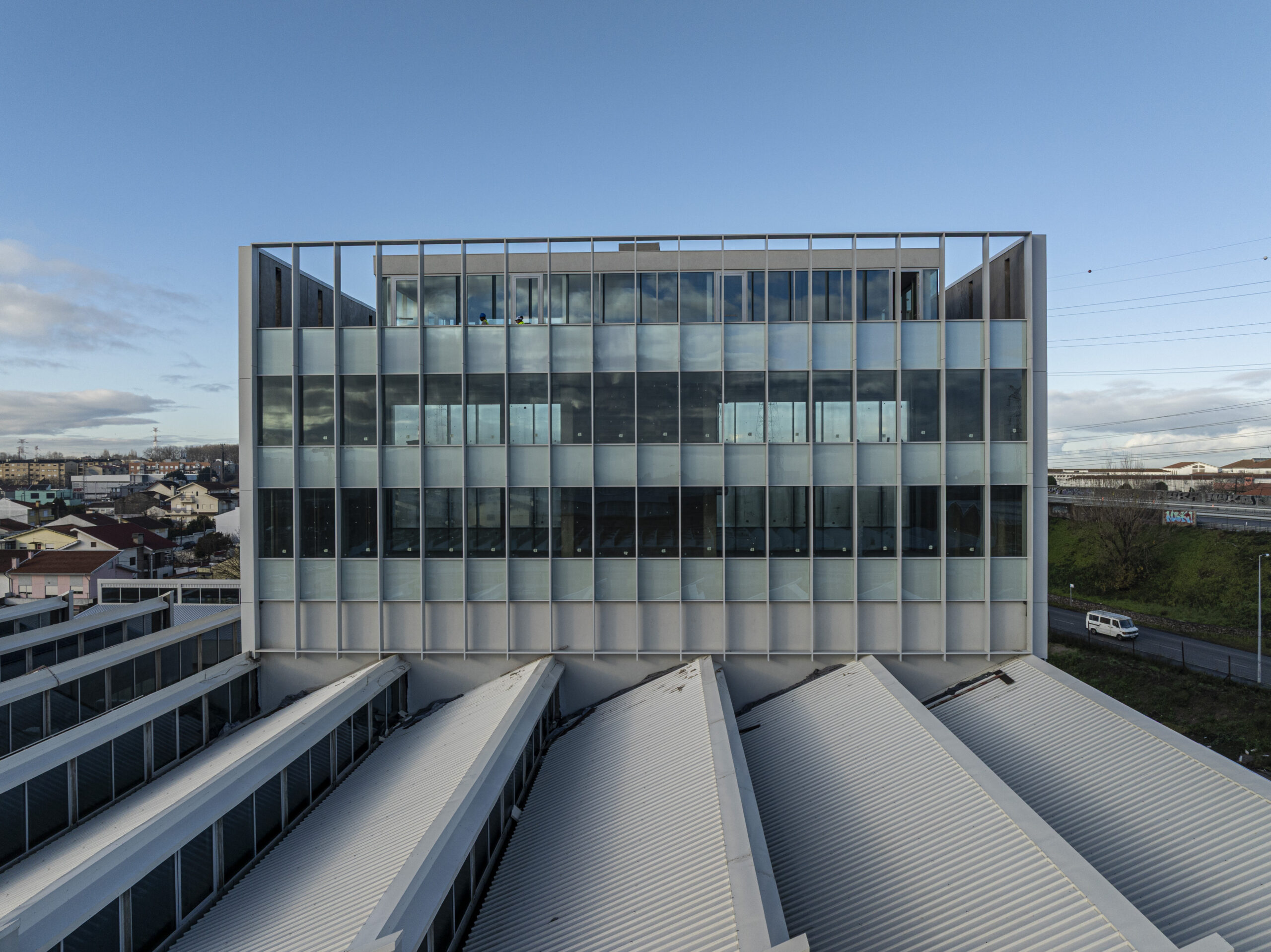
Projects such as BUZ at La Movida or Spark, developed through the regeneration of a former industrial area, show how regeneration can create new uses without erasing the memory of place. In these cases, adapting existing structures allows urban assets to be transformed into contemporary, more efficient spaces prepared for new ways of working and living.
In this sense, every project decision should consider not only what is built anew, but also what can be recovered, adapted and reintegrated into the city.
Tools such as BIM reinforce this transformation. By enabling the simulation of solutions, the quantification of materials and the anticipation of conflicts during the design phase, BIM supports more informed and efficient decisions.
BIM can support decisions related to:
At Castro Group, BIM has always been understood as a strategic tool. Its adoption resulted from an early recognition of the importance of digitalisation in the sector, helping improve coordination between disciplines, optimise design decisions and strengthen control over cost, timelines and quality.

Certifications are no longer merely recognition labels. Today, they function as strategic tools to guide design decisions, measure performance and ensure that buildings respond to increasingly demanding criteria of sustainability, efficiency, well-being and resilience.
In real estate, systems such as LEED, BREEAM, WELL, WiredScore and SmartScore help structure a more comprehensive approach to the lifecycle of assets. Each addresses different dimensions: environmental performance, user health and comfort, digital connectivity, building intelligence, operational efficiency and future readiness.
In the context of embodied carbon, these certifications encourage a more rigorous assessment of materials, circularity, resource sourcing and the efficiency of construction solutions. At the same time, they reinforce an essential principle: a sustainable building must be conceived as such from the outset.
Back to the top