


 All News
For decades, assessing the sustainability of a building meant measuring what it consumed in operation: energy, water, and emissions. It is a relevant metric, but an incomplete one.
Embodied carbon, the emissions generated in the extraction, production and transport of construction materials, as well as in the construction process itself, can represent between 30% and 50% of a building’s total impact over its lifecycle. And unlike operational emissions, this carbon cannot be reduced with solar panels or efficient management systems: it has already been emitted before the first person walks through the door.
It also means erasing the infrastructure that the city took decades to build: networks, services, connections, memory.
Rehabilitating means, to a large extent, not emitting that carbon. It means starting from what already exists rather than beginning from zero, and that has concrete environmental consequences that are rarely accounted for.

That said, rehabilitation is not, in itself, a guarantee of sustainability. A building rehabilitated without rigour, with inefficient energy systems, poor waste management or insufficient attention to indoor environmental quality, can have a considerable impact. The equation is more demanding than simply “not demolishing”.
Rigour is therefore non-negotiable. This is where certification plays a role that goes beyond recognition at the end of the process; it functions as a decision-making framework from the very beginning. It requires measurable objectives to be defined, choices to be documented, and real results to be assessed – not just intentions.
Without rigour, rehabilitation is merely preservation. With rigour, it is a transformation.

Portugal has a built environment with unique characteristics: significant historical density, a relevant stock of buildings with conversion potential, and growing pressure on available land in the most sought-after areas.
In this context, urban rehabilitation is not a niche option. It is a structural response to a structural problem: how do cities grow, adapt and renew themselves without destroying what already exists or expanding indefinitely into the periphery?
The urban scale is, therefore, where the case for rehabilitation becomes most evident and most overlooked.
Every rehabilitated building is a building that did not generate new pressure on available land, that did not require new infrastructure, that did not break the continuity of a street or a neighbourhood. It is also a building that returned to the city a space that was out of use, without erasing the identity of the place.
The most resilient cities are not those that build the most. They are those that best manage what they already have, adapting, converting, and extending the useful life of the built stock rather than systematically replacing it.
The sustainability of a city is not measured building by building. It is measured in the way those buildings relate to what exists around them, the infrastructure, the people, and the time. And in that sense, rehabilitating with purpose is not just the most sustainable decision. It is, increasingly, the most intelligent one.

For a developer with a diversified portfolio, buildings of different eras, uses and states of conservation, certification is not merely a validation instrument. It is a strategic asset management tool.
The first relevant aspect is that the main certification systems were designed precisely to address this diversity. LEED, for example, offers distinct rating systems depending on the nature of the project: BD+C (Building Design and Construction) for new construction or major rehabilitation projects; O+M (Operations and Maintenance) for buildings in operation seeking to certify and continuously improve their performance; and ID+C (Interior Design and Construction) for interior fit-out works. BREEAM follows a similar logic, with its New Construction, Refurbishment & Fit-Out and In-Use schemes, each calibrated to the type and scale of intervention. This architecture allows a developer to apply the same reference framework to buildings at completely different stages of their lifecycle — without forcing a direct comparison between distinct realities, but maintaining a common language of assessment.
The second aspect is the growing alignment between certification and European regulation. The revised Energy Performance of Buildings Directive (EPBD 2024/1275) introduces progressive minimum performance requirements for the existing building stock, with particular pressure on the worst-performing buildings, the so-called Minimum Energy Performance Standards (MEPS). For developers with older assets in their portfolio, certification functions as regulatory anticipation: it ensures that buildings are aligned with standards that, in time, will no longer be voluntary. Similarly, the EU Taxonomy and the reporting requirements under CSRD/ESRS require real estate assets to demonstrate alignment with measurable technical sustainability criteria.
The third aspect is the impact on asset value. Research by MSCI and JLL consistently shows that certified buildings achieve value and rental premiums over non-certified buildings in comparable markets, as well as lower vacancy rates. In a context where ESG criteria carry increasing weight in institutional investment decisions, the absence of certification is beginning to be read not as an omission, but as a risk.
In a portfolio committed to sustainability, certification does not distinguish between new and rehabilitated. It distinguishes between well done and poorly done and makes that distinction verifiable by any investor, tenant or regulator.
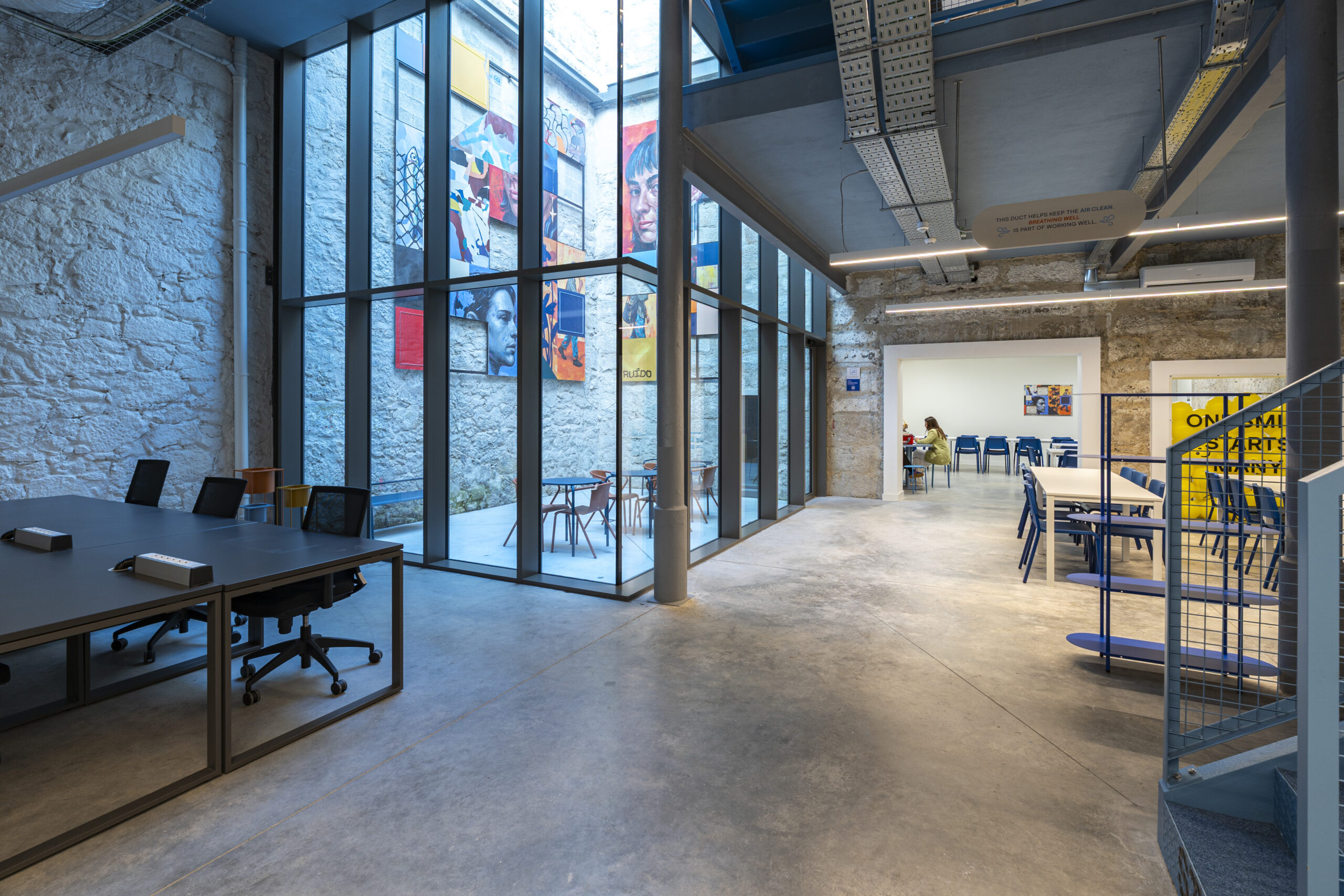
In Matosinhos Sul, in a vacant building dating back to before 1951, Castro Group developed the first Buz project, today the first flex working space with LEED certification in Matosinhos and the only building in the city certified under the LEED v4 BD+C: New Construction rating system. The process of obtaining LEED Gold certification left concrete lessons about what it means to rehabilitate with rigour.
The first: the most important decisions are not made on site. They are made during the design phase, when it was still possible to define that 64% of the original structural elements would be preserved, that water systems would be designed to reduce consumption by more than 71%, and that natural light would be maximised through a new light well. By the time construction begins, the impact has already been largely determined.
The second: rehabilitating a building is also an act of urban responsibility. Returning to the city a structure that was out of use — rather than replacing it with something new — is a decision whose impact extends beyond the boundary of the plot. It contributes to the coherence of the urban fabric, to the memory of the place, and to the human scale of the city.
The third: sustainability and occupancy are not competing objectives. Buz at La Movida reached 100% occupancy and received the 2026 National Urban Rehabilitation Award in the Best Sustainability Solution category — confirming that the market recognises and values the difference.